

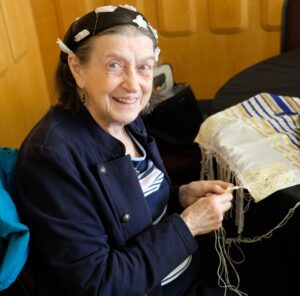
 Whether you’re at KBI services, learning or cultural programs, you’re likely to see Dr. Agnes Klein there. This active octogenarian just recently retired from a 52-year career at Health Canada. Joy Moskovic, of KBI’s Communications & Marketing Committee, recently interviewed Agnes.
1. What do you love most about being part of this congregation?
It’s a very congenial environment, people are nice, and when somebody new comes, they (other congregants) always go up and introduce themselves to make sure that they are a part of the community. It’s a two-way street. It’s not only people who have to come to you, but you also have to reciprocate.
2. Where did you grow up?
I grew up partly in Romania, and in Uruguay, South America. I was almost 10 when we got to South America. For five months or so, we were in France waiting for a liner to be able to cross the Atlantic and I went to school there for one term. We were there from August 1946 until Christmas of that year.
3. How did you survive in the 1940s in Romania?
We were in a little town in Transylvania, which was the winter resort of the royal family, which is why it wasn’t annexed to the Austro-Hungarian Empire.
Once the Nazis came in, they conscripted men for road work, so my father was always somewhere. The Iron Guard was looking for him. But he just didn’t have the physical strength to do roadwork, so he was on the run. He was a chartered accountant, and he had lost his job. They’d kicked him out when the Germans came in, but until then he had been an accountant in Vienna at the Austro-Hungarian bank and then when he moved back to Romania he was the chief accountant in a textile factory.
Nobody was taken to (concentration) camps. I remember there was panic in town; it must have been 1944 to 1945 and people were running all over the place and leaving town, including the Jewish folks. I was about seven at the time. I didn’t know what the issue was.
4. What made your family choose Uruguay in 1947?
A lot of people had gone there between the two world wars. My mother had siblings who had gone there. They were cavalry officers in the Austro-Hungarian Empire in World War I, and when the War was over, the oldest, my mother’s oldest brother, said, “I have had enough of Europe. I’m leaving. I’m going wherever.” You couldn’t get into the U.S. You just couldn’t. This is where they wanted to go.
So, they played Pin the Tail on the Donkey, and that’s how they happened to choose Uruguay.
5. When and how did you come to Canada?
In 1962. I arrived in Toronto on the August long weekend. We moved to Toronto a few years later.
6. What, in your career, engaged you to continue working at Health Canada for 52 years?
I stayed for that long because I found that I could contribute. The work was for the benefit of the people of Canada. Also, science and medicine were advancing fast, and I kept learning newer and newer and better ways to make the decisions needed for drug regulations in the context of the new knowledge in medicine and therapeutics.
7. What are you most proud of in your career? Any specific achievements?
It’s the many friends I made and mentorships I was able to provide to several generations.
This is a very hard question as I was involved in several critical endeavours. The ones that stand out are my contributions to the ethics of clinical trials in conjunction with the Medical Research Council, as well as to the initial organization of the Biologic and Genetic Therapies Directorate, now called the Biologic and Radiopharmaceutical Drugs Directorate to which I brought the clinical knowledge of the more modern radiotherapies.
8. What’s something people might be surprised to learn about you?
At one time, we owned a farm in the Ottawa Valley. We used to go there every weekend. We bred cattle for beef.
We had the land for about 20 years. My husband was very happy there; he liked to work in the fields and make hay. He grew up in the countryside in Romania, but they didn’t have large cattle; they were primarily growing vines for kosher wines.
9. Do you have a favourite Jewish movie or music or book?
I read an interesting article recently. It’s by an academic named Aviel Roshwald who analyzes the period just before World War I, through to after World War II. It looks into the Jewish communities in Central, Central Europe and Eastern Europe, and a little bit of Western Europe.
10. If you could have dinner with any Jewish figure (past or present), who would it be and why?
I think it would be Herzl (Theodore Herzl, the founder of modern Zionism) to see what he’d say about the world today.
11. You are a very active member at KBI. What does synagogue participation give you?
I think it gives me satisfaction and peace.
12. What advice would you share with a new KBI member?
You’re going to a congregation that is very congenial, but you have to put some work into it too. Make sure that you talk to people, and you can do as much volunteering as you want.
13. How do you continue your Jewish learning?
Right now, I’m learning, relearning, and improving my Hebrew. I’m taking classes online from Israel.