

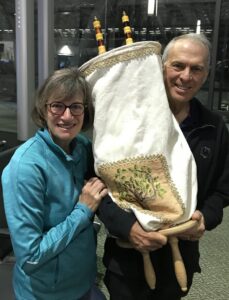
 For Helen Zipes, being part of a community means participating in it. Whether through her distinguished career in healthcare, her leadership and involvement at KBI, or her commitment to family, learning and service, Helen brings energy and enthusiasm to everything she does. Far from slowing down in retirement, she continues to work, teach, volunteer and embrace new challenges—with time left for golf, Mandarin lessons and, remarkably, reading Torah—as she explains to Communications & Marketing Committee member Suzan Zilahi.
1. Let’s start at the beginning. Where did you grow up, and what path did you take professionally?
I grew up in Montreal. I’m the middle child between two brothers. I went to McGill University and graduated as a physiotherapist.
My husband, Rick and I were married in Montreal, and we lived there for a year. Then his company asked him to move to Ottawa, so we moved here in 1977. Last month we celebrated our 50th wedding anniversary!
I later went back to school and got an MBA and moved into hospital management. My whole career revolves around the hospital system. I was the Clinical Director of The Ottawa Hospital Rehabilitation Centre and the Academic Family Health Team.
After I retired from the hospital, the University of Ottawa contacted me and asked if I would be interested in creating a course for the MHA (Master of Health Administration) program at the Telfer School of Management on governance and ethical management in healthcare. I’ve been teaching it ever since, for about three years.
This year the program is expanding internationally, so I’ve also been asked to adapt the course for students in the Middle East and the year after it’s going to China.
I’m also currently serving as the Vice-Chair of the Kemptville District Hospital Board and will become Board Chair next year.
I’m definitely not retired! I like being busy and active. It keeps you young.
2. Who were some of the people who had the greatest influence on you growing up?
Certainly my parents. Although things were very tight when we were growing up, they were very philanthropic and extremely devoted to our synagogue (Shaare Zedek).
However, a big influence was my late younger brother, Gerald, who was developmentally delayed and quite severely disabled. That had a very big effect on both my older brother and me and prompted us both to go into “helping professions”.
3. How did you first become involved in Jewish life in Ottawa?
Growing up in Montreal, going to synagogue for Shabbat and all the holidays was our normal. Rick and I were actually founding members of Beth Shalom West in Ottawa but our daughter, Erin, wanted to have a Bat Mitzvah, so that was when we switched to Agudath Israel Congregation.
One of the things that really impressed me about Agudath Israel was the way they treated and included individuals from Tamir. Because of my younger brother, seeing how welcoming they were and how they included people with disabilities really meant something special to me.
4. What has the KBI community meant to you over the years?
In 2005, my father died very suddenly. My father had said Kaddish for his parents, and I knew he would have liked for us to do the same, so I did.
I went to minyan twice a day, and the Minyanaires were incredibly welcoming and supportive.
One of the Minyanaires asked if I would like to learn how to chant a Haftarah. That was completely foreign to me. Bernie Rosenblatt taught me the trope, and I began doing Haftarah readings. Rabbi Kenter was also very encouraging and then I started leading services, and now I am part of the regular cadre of Torah readers.
The amount of lay participation we have, I believe, is the real strength of KBI. People lead services, read Torah and take part in so many different ways.
5. Tell me about your service in the leadership roles you took on at KBI?
I was asked to take on the presidency of the synagogue, and I served during the early period following the amalgamation of Agudath Israel and Congregation Beth Shalom.
KBI has really benefited from the traditions of both congregations. You can clearly see the strengths of both coming through. I love how participatory and welcoming KBI is as a congregation and there is a wonderful group of regular synagogue attendees. The after service Kiddush is a great opportunity to connect with each other and people tend to sit and chat.
I especially like seeing the building so occupied. There is something happening almost every day of the week. It should be part of the community and be there for people through all of life’s events.
6. You’re still very actively involved with KBI. What are you doing now?
One of my volunteer roles right now is working with the Bar and Bat Mitzvah families. I really enjoy meeting with the families and getting them involved and organizing the honours for their big day. We encourage family and friend involvement, which really adds to the meaningfulness of their simchah.
Between this year and next, we have about 30 Bar and Bat mitzvahs scheduled. I think that says something about the ongoing health and viability of our synagogue. We’re definitely growing.
7. Which of your accomplishments are you especially proud of?
First and foremost, I’m proud of my husband, children, Erin and Kyle, and grandchildren.
I always say: I have grandchildren, I’ve had my hole-in-one, my son-in-law gave me a part in a movie, and I read Torah. I can die happy now.
We have two children, a girl and a boy, and each of them has a girl and a boy. One has a female dog and the other a male dog, so it is a perfect distribution.
Our daughter and her family live here in Ottawa, and their children are both starting university this year—one at McGill and one at Queen’s.
Our son and his family live in Northern California, where we have the privilege of spending the winter, to be near them.
I’ve also been studying Mandarin. My son’s wife is Chinese, so I thought it would be nice if I learned her language. My grandchildren in California attend a Mandarin immersion school, and they’re my biggest helpers and supporters. Whenever I have questions, they help me. Golfing at Rideau View is definitely my happy place. My husband and I are both golfers, and we have developed wonderful friendships through golf. It’s also a very humbling sport. With almost any other sport, if you’ve been doing it for 25 years, you’d probably be an expert. Golf doesn’t work that way—you get better, and then you get worse!
My husband and I have both had holes-in-one. They were a few years ago and occurred two weeks apart.
I’m also especially proud that I learned to read Torah. I never imagined I would be able to do that.
There was another experience that was incredibly meaningful to me: bringing a Torah to a Jewish community in Tanzania.
8. How did that come about?
The Jewish community in Tanzania needed a Torah. After the amalgamation of our two shuls, we had extra Torah scrolls, and through a series of connections, their community reached out to us. We were happy to provide them with one of our Torahs.
In 2019 a group of us from the Shul, led by Rabbi Kenter, escorted it to Tanzania.
When we arrived, they met us at the airport and as we brought the Torah into their congregation, they sang and danced with the Torah under a Chuppah and spread rose petals on the ground. It was magnificent.
Rabbi Kenter read from the Torah for them, and we spent several days with the community. It was an extraordinary experience.
On Shabbat after services, I said that if anyone wanted help with their Hebrew reading, I would be happy to help. I couldn’t believe how many people crowded around me—mostly young men and women. I promised them I would stay that day as long as they needed me.
For several years afterward, I continued teaching Hebrew online to a group of young people there. One young man, Binyomin, became so proficient that I eventually helped prepare him for his own Bar Mitzvah. Binyomin now teaches the rest of the community to read and chant.
That trip was life-changing. Seeing a community work so hard and bear so much to maintain their religion and traditions was truly inspiring.
Read more about the remarkable journey to Tanzania:
Emotional story: Bringing a Torah to Tanzania
Ottawa congregation delivers Torah scroll to beleaguered Tanzanian Jewish community
9. If you could have dinner with any Jewish figure, past or present, who would it be?
There was a large Karsh portrait of Jonas Salk, near my office at The Ottawa Hospital Rehabilitation Centre. I was so impressed with Dr Salk. He purposely did not patent or collect royalties or ownership for developing the polio vaccine.
There is a quote attributed to him about this. Journalist Edward R. Murrow asked him who owned the patent during a 1955 televised interview, Salk famously answered, “Well, the people, I would say. There is no patent. Could you patent the sun?”
I would ask him all about his process for developing the vaccine and philanthropy and whether his Judaism contributed to his decision.
* Helen and Rick have just celebrated their 50th wedding anniversary! To mark this wonderful milestone, they’re embarking on an extraordinary adventure, travelling to the ends of the Earth—Antarctica! Bon voyage, Helen and Rick!